
A growing body of research shows that reading poetry is good for you. Whether you love it, hate it, or have bad memories of trying to decipher it in school, read on to learn about the benefits that poetry offers — and how to find poems you might enjoy.
If you’re wondering if poetry even matters in our technology-driven world, consider how former U.S. Poet Laureate Ada Limón responded to this question in an April 2025 interview with NPR:

What if poetry can bring you back to wonder, to kindness, to care, to sensitivity, to tenderness? And even in that small moment, isn’t that a radical act? Isn’t that saving yourself so that you can become stronger? So that you can become braver?
The state of poetry
As long as humans have been writing, we’ve been writing poems. And some historians believe the form predates literacy, that it was first an oral tradition. Today, poetry — written and spoken — is alive and well! Check out Poetry in Motion, a program that began in 1992 in New York City and places verses in urban transit systems around the country, exposing it to millions of riders every day. Or browse these rich online resources offering a poem each day, poet bios, and searches to quickly find poems by topic or theme:
Poetry slams began in the 1980s as a way to move poetry from academia to public spaces. These spoken-word competitions, along with slam poetry (their non-competitive counterparts), are held in communities around the globe. The Academy of American Poets website has a tool for finding poetry events near you.
Science meets art
Researchers have put this enduring art form to the test, to gauge its impact on the reader or listener. Here’s a sampling of studies:
- Participants in a virtual poetry community experienced mental health benefits during the difficult days of the COVID-19 pandemic. (University of Plymouth, England, 2023)
- Poetic expression was found to be an effective support tool in treating the trauma experienced by unaccompanied refugee minors. (University of Gothenburg, Sweden, 2022)
- Brain imaging shows that that the nucleus accumbens, an area of the brain involved in pleasure, is triggered when poems evoke a mix of joy and suffering and when lines directly address the reader, using the second-person pronoun “you.” (Max Planck Institute for Empirical Aesthetics, Germany, 2017)
Other researchers have found that poetry delights the reader more than prose because it engages the brain’s ability to detect patterns and untangle associations. Poems may require more thought, but that comes with reward and even surprise when you discover something new.
How do you engage with poetry?
(especially if you have an aversion to it)
Not all poetry is difficult to understand or classic or old. There’s poetry for every reader, of every age. The best way to zero in on what you might like is to visit the library. (Online resources are terrific, but sometimes you need page through some books to find what you’re looking for.)
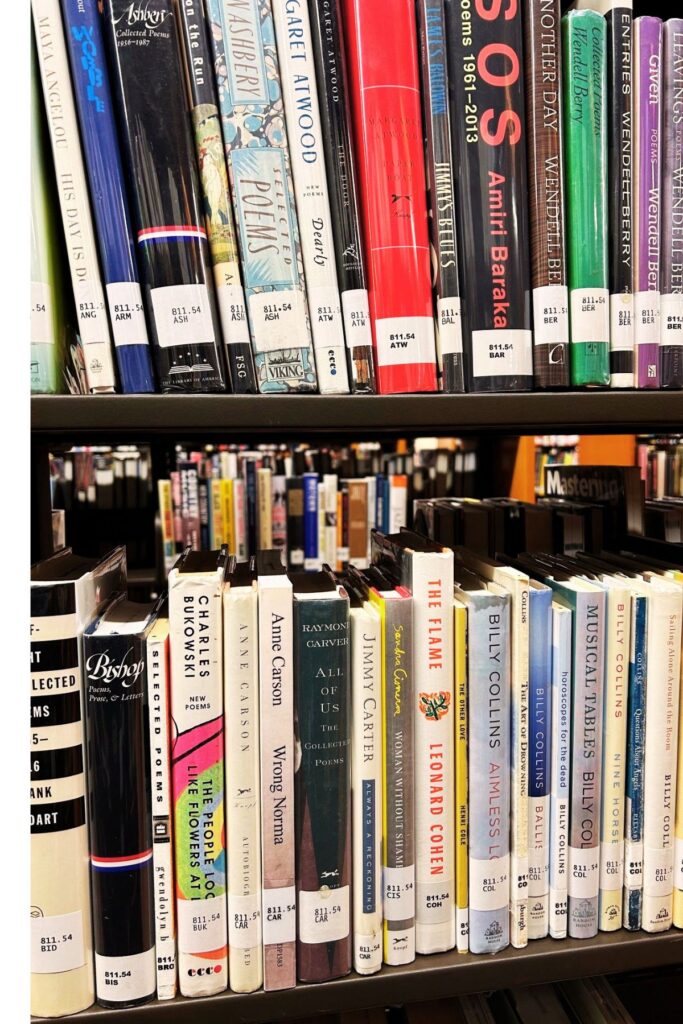
Begin by browsing: Head to the 808.81 shelves for anthologies/collections, 811 for American poetry, and/or 821 for English poetry in either the youth or adult areas.
Children’s poetry is a great starting point for any age and often comes with the bonus of being delightfully silly. Head to J808.81 for anthologies/collections, J811 for poetry by American writers, and/or J821 for poetry by English writers.
When you find a poem you like, read the lines out loud — to yourself or to others. It’s a great way to fully appreciate the rhythms and sounds of poetry.
Find out more! The more you know about something, the richer the experience. For example, stanza is from the Italian word for room, which clarifies the meaning of poet Billy Collins’s entreaty to “walk inside the poem’s room / and feel the walls for a light switch.” To learn more about poetry’s terms and techniques like rhythm, rhyme, and figurative language, explore the 808.1 shelves.
If you’d like recommendations, stop at the Adult & Teen Services or Youth Services desk to talk with a librarian. Staff are always happy to connect a reader with a good book!


